
Author: The Kernel and Kiersten Sundell

The United States has struggled for decades to deploy new nuclear reactors. Now, dozens of companies are racing to break that streak, each convinced that their advanced technology will arrive first and reshape American energy. Holtec International’s approach is strategic, not revolutionary: conventional pressurized water reactors made smaller, built on property they own, operational in four years or less.
The SMR-300
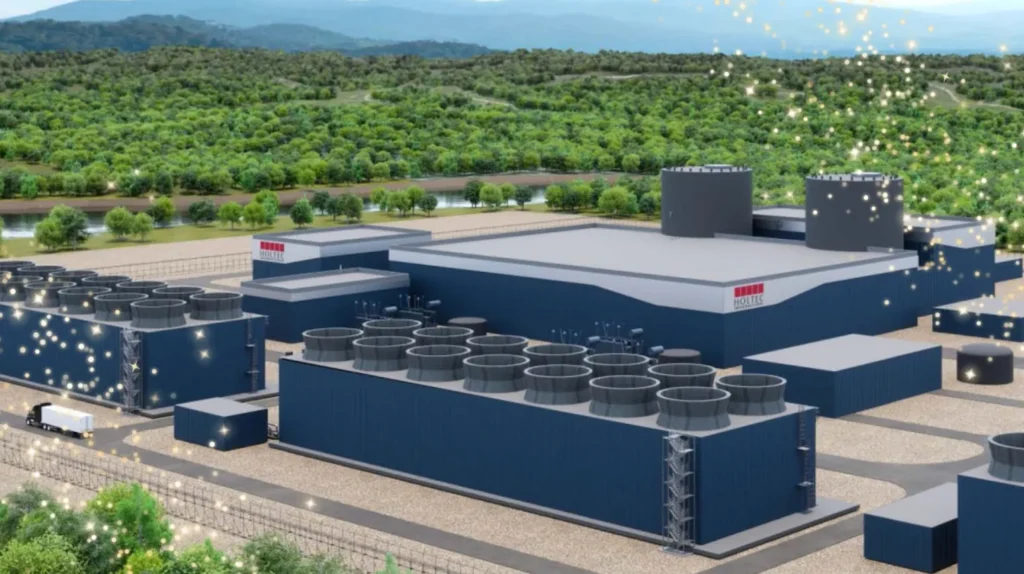
Their advanced reactor is called the SMR-300, a 300-megawatt pressurized light water reactor that uses the same low-enriched uranium fuel as traditional plants. It’s essentially a smaller, safer version of reactors that have been running since the 1960s.
Like other Gen III+ designs, Holtec’s reactor vessel promises “walk-away safety.” A water reservoir between the containment building and the outer concrete wall creates a permanent cooling source that doesn’t depend on pumps or external power, meaning that if operators abandon the facility during an emergency, the reactor shuts itself down and stays cool indefinitely.
For normal operations, the SMR-300 offers flexibility for water-scarce regions. While the reactor’s safety systems use water, the plant’s cooling towers can use fans, eliminating the massive water consumption traditional plants require. And all reactor components measure 12 feet in diameter or less, enabling factory fabrication and transport by standard rail or truck.
Roadmap to Operations
In August 2025, Palisades officially transitioned from decommissioning back to operations status under NRC oversight, making it the first nuclear plant in U.S. history to do so. The plant is authorized to receive fuel and restart once final preparations are complete. When it comes back online, it’ll produce 800 megawatts of clean electricity , which is enough to power 800,000 Michigan homes. This historic achievement was made possible through federal support from the Biden administration, state leadership from Governor Whitmer, and the commitment of utility customers willing to purchase the plant’s output. And nuclear advocates, of course.
In February 2025, Holtec launched “Mission 2030,” a program targeting 2030 for the first commercial operation of the twin SMR-300s at Palisades. They’ve invested over $50 million in site development work, including environmental studies, soil borings, and a groundwater monitoring program. They’re planning to submit their construction permit application to the NRC in early 2026, with construction beginning mid-2027 if approved.
To build it, they’ve partnered with Hyundai Engineering & Construction, the South Korean company that recently completed the four-reactor Barakah Nuclear Power Plant in the United Arab Emirates on schedule—a rare achievement in the nuclear industry. The expanded partnership announced in 2025 covers building a 10-gigawatt fleet of SMR-300s across North America through the 2030s, starting with Palisades.
Holtec already has customers lined up. Wolverine Power Cooperative and Hoosier Energy have signed long-term power purchase agreements for the full output, serving rural communities in Michigan, Illinois, and Indiana.
The Assessment
The risk isn’t technical—pressurized water reactors work. The risk is execution. Can Holtec actually deliver by 2030? Can they avoid the cost overruns that have plagued recent projects? And can they prove that building small means building faster and cheaper? If Holtec sticks to their timeline, they could be first to achieve advanced reactor criticality in the United States. If they fall behind, they won’t be alone.
Head over to our TikTok or Instagram to watch our video review of Holtec’s advanced reactor progress!