
Author: The Kernel and Kiersten Sundell
Most companies in the advanced reactor race are trying to scale down gigawatt-sized nuclear plants into something commercially viable. Radiant Nuclear, founded in 2020 by former SpaceX engineers, is taking the opposite approach: build something so small it fits on a single truck, then factory-generate dozens of them per year.
Coming Back to Earth
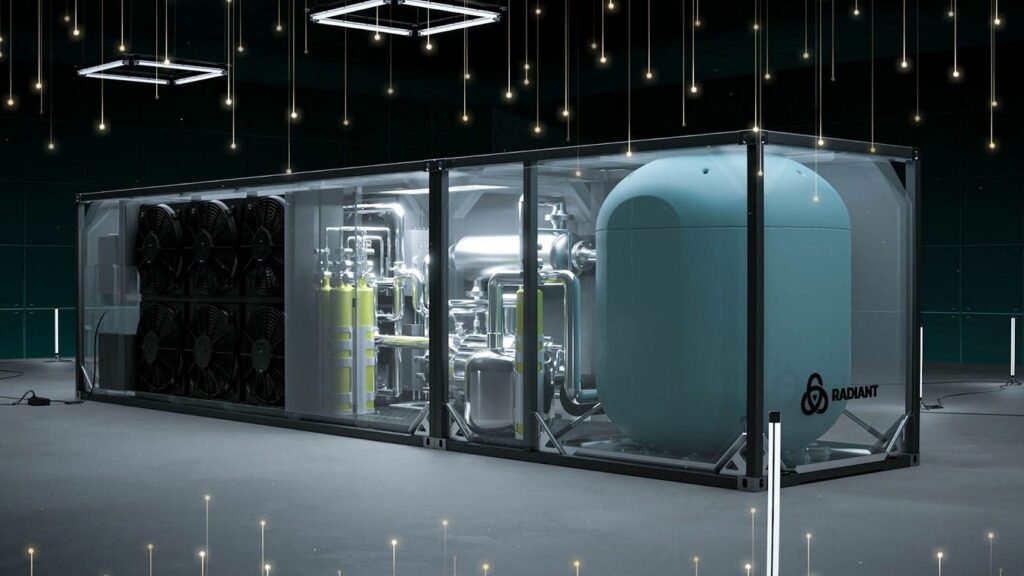
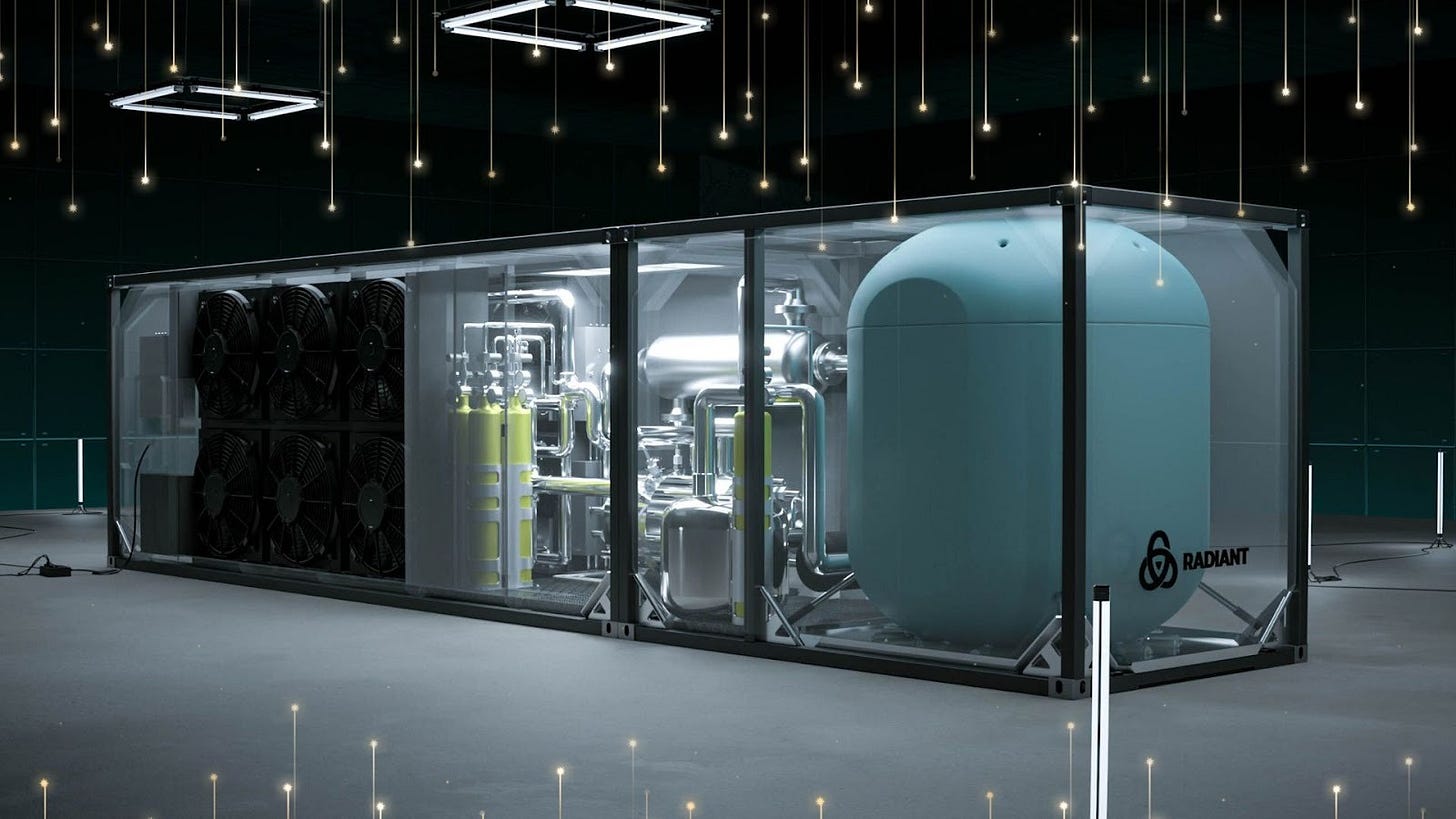
Their design is called Kaleidos, a one megawatt microreactor that uses TRISO fuel and helium cooling. The entire system fits in a shipping container, requires no site excavation, and can theoretically be dropped off and plugged in within 24 hours. It’s designed to replace diesel generators, which means it needs to be truly portable — not “portable with six months of site preparation and a small army of specialists.”
The reactor uses air cooling via forced convection (aka fans), and can run for several years before refueling. It’s perfect for remote areas, and unlike competitors, doesn’t require a dedicated water supply.
But here’s where Radiant’s plan gets (very) ambitious. They don’t want to build reactors one at a time, proving each one works before building the next. They want to build a factory that produces 50 microreactors per year.
In October 2025, the company announced it will build its first manufacturing facility, called R-50, at a former Manhattan Project site in Oak Ridge, Tennessee. It will require a $280 million investment and create 175 new jobs, with a long-term goal of producing dozens of reactors per year, though no company has yet produced nuclear reactors at this scale. It assumes you can standardize, automate, and quality-control nuclear manufacturing the way Boeing builds airplanes or Tesla builds cars. This might work, but it also might be spectacularly complicated.
The U.S. Department of Energy selected Radiant for the Advanced Reactor Pilot Program, which requires participating companies to achieve criticality by July 4, 2026. That’s building and starting up a reactor in less than a year, which is ambitious, to say the least. Radiant will conduct initial testing at Idaho National Laboratory’s DOME (Device for Observing Modular Energy) facility beginning Spring 2026.
The Department of Defense awarded Radiant a contract in August 2025 to deliver one unit to a military installation by August 2028. Each Kaleidos displaces approximately 1.8 million gallons of diesel fuel annually, which is a 110-fold improvement in energy density compared to conventional generators. But the convenience comes with a lofty price tag. The military might be able to front the cost of flexible power, but does the public want micro technology this expensive? Only time will tell.
The Assessment
Mass-producing several microreactors per year, let alone 50, has never been done. Nuclear manufacturing has always wanted to be industrial and repeatable, but has never gotten there yet — at least in the United States. If Radiant can pull it off, they’ll change the game. If they don’t, they’ll have built a very expensive factory in Tennessee.