
Author: The Kernel and Kiersten Sundell

A technical competition is underway to determine which company will be first to navigate regulatory approval, secure financing, and commercially operate an electricity-generating advanced nuclear reactor in the United States. We’re calling it the Advanced Reactor Race™, and most U.S. based companies are inventing new designs from scratch. Kairos Power is perfecting a design that worked in the 1960s but never achieved commercial deployment.
All U.S. molten salt reactors trace their lineage to the Molten Salt Reactor Experiment (MSRE) that operated at Oak Ridge National Laboratory from 1965 to 1969. The experiment proved that molten salt coolant works, that fluoride salts can transfer massive amounts of heat, and that the concept is scientifically sound. What it didn’t prove is that the technology could operate economically at commercial scale.
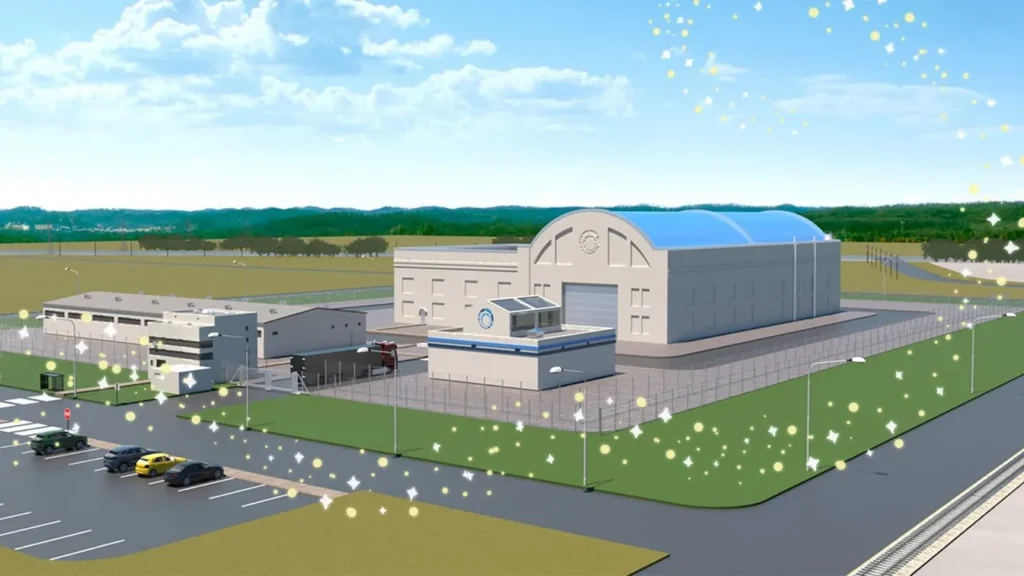
Kairos, founded in 2016, is attempting to finish what Oak Ridge started. Their reactor is called Hermes, named after the Greek god known for speed. Whether this naming choice actually accelerates construction timelines is still up in the air.
Hermes is a fluoride salt-cooled high-temperature reactor using a molten salt mixture called Flibe — a combination of lithium fluoride and beryllium fluoride. Flibe can transfer enormous amounts of heat at low pressure, which eliminates the thick pressure vessel walls required by water-cooled reactors and reduces certain accident scenarios. Unlike the original MSRE, which dissolved fuel directly into the liquid salt, Hermes uses solid TRISO fuel pebbles. Uranium atoms split inside the ceramic-coated pebbles, releasing heat that the liquid Flibe carries away through natural circulation—no pumps required.
In 2023, Hermes earned a construction permit from the NRC, making it the first non-light water reactor design permitted in the United States in over 50 years. It was a regulatory milestone, and construction began at Oak Ridge in May 2025. The initial version is a test reactor designed to prove the technology works. It will only produce heat, not electricity, which simplifies regulatory requirements and lets Kairos demonstrate that Flibe cooling performs as predicted in operational conditions.
But Kairos isn’t just building one reactor at a time — they immediately applied for construction permits for Hermes 2, an electricity-producing version using identical nuclear technology but adding steam turbines. The NRC reasoned that if Hermes 1 was safe to build, Hermes 2, which uses the same reactor technology, should be safe too. Both permits were approved. Hermes 1 is now targeted for operation in 2027, while Hermes 2 is scheduled for 2030.
And Kairos isn’t just building reactors — they’re also working to mass-manufacture their coolant. They’ve constructed a molten salt production facility in New Mexico and recently operated the world’s largest Flibe system at their Engineering Test Unit , which became the largest molten salt transfer since the 1960s experiments. Manufacturing Flibe at commercial scale hasn’t been done before, as the beryllium fluoride component is particularly challenging to produce in quantity. Kairos is developing this capability in tandem with reactor construction, which adds technical risk but addresses a fundamental supply chain gap.
In October 2024, Google announced a power purchase agreement with Kairos for 500 megawatts of nuclear capacity to be delivered between 2030 and 2035. The deal, structured through Tennessee Valley Authority (TVA), is the first corporate agreement to purchase nuclear energy from multiple small modular reactors.
This commitment has encouraged other buyers to invest in advanced nuclear too. While traditional utilities have been hesitant to commit to unproven reactor designs, tech companies facing exponential data center growth and carbon-free energy requirements are willing to take the risk. The agreement gives Kairos financial certainty to continue construction and provides evidence of actual customer demand for advanced reactor output.
The Assessment
If Hermes 1 achieves criticality in 2027 as planned and demonstrates stable operation, Kairos will validate five decades of molten salt research and potentially open pathways for other advanced designs. If unexpected materials or operational challenges emerge, they’ll discover why commercializing MSRE was so difficult in the first place. Either way, they’re actually building the thing, which puts them ahead of most of the competition.
Check out our video explainers on TikTok and Instagram!