
Author: The Kernel and Kiersten Sundell
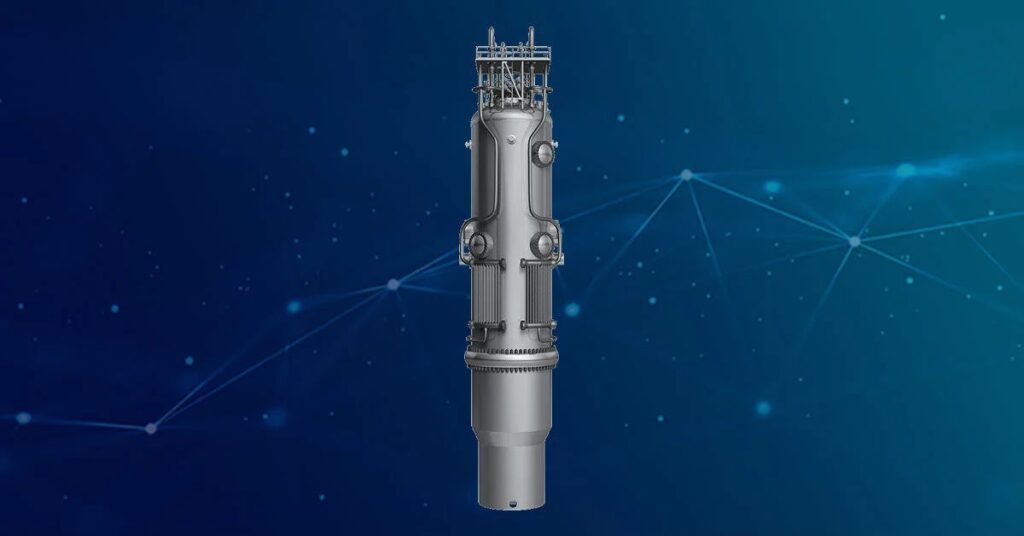
As federal subsidies, climate commitments, and ever-growing data centers demand clean power, more than a dozen companies have joined the race to deploy the first commercially successful advanced nuclear reactor. The question is, who will be first?
NuScale is currently the only small modular reactor (SMR) company in America with NRC design approval, a feat that took several years and hundreds of millions of dollars. NuScale’s first design was certified in January 2023, and in May 2025, they got approval for their updated 77-megawatt design.
The NuScale Power Module is as tall as a six-story building and narrow enough to ship by truck. Each module generates 77 megawatts using conventional solid fuel and water coolant, relying entirely on natural circulation rather than mechanical pumps.
Most plants depend on electric pumps to circulate cooling water continuously, but in the unlikely event that those pumps fail and backup power is lost (like we saw at Fukushima), the consequences can be severe. NuScale’s design eliminates this risk. Hot water is less than cold water, so it rises through the reactor core, cools at the top, becomes denser, and sinks again. The system operates on physics alone.
The entire module sits in a pool of water 53 feet deep — eight times deeper than an Olympic swimming pool. According to NuScale, this provides an “infinite period of cooling” in the event of a total loss of power, because gravity and natural circulation keep working even if everything else fails. It’s also designed to ramp up or down to match grid demand, unlike traditional plants, which are made for reliability and can take days to stop and restart — ideal for grids saturated with renewables.
The Timeline Problem
Having NRC approval is a massive head start, but it doesn’t guarantee commercial success. In November 2023, NuScale’s flagship project in Idaho was cancelled when costs nearly tripled from $3.6 billion to $9.3 billion. The Utah Associated Municipal Power Systems project was set to turn on by 2030, becoming the first NuScale plant in the United States, but utility partners dropped out, and the project collapsed.
Since then, NuScale has pivoted to other markets. In September 2025, they announced a landmark partnership with Tennessee Valley Authority and ENTRA1 Energy to deploy up to 6 gigawatts of NuScale capacity across TVA’s seven-state service region. That’s six ENTRA1 Energy Plants, each powered by multiple NuScale modules — enough to power a city the size of Dallas-Fort Worth. It’s the largest SMR deployment program announced in U.S. history.
They’re also working on a 462-megawatt plant in Romania at a former coal site in Doicești. The project has backing from multiple international agencies, including a $275 million commitment from the U.S. Export-Import Bank and letters of interest for up to $4 billion in additional financing. Romania wants the plant operational by 2029. We’ll see how that timeline works out.
Tech companies are interested too. NuScale has been in discussions with data center operators, industrial customers, and utilities about supplying carbon-free power. In their Q1 2025 investor presentation, they said they’re “no longer chasing memoranda of understanding” — they’re negotiating contracts with customers who “want to touch steel.”
Manufacturing partner Doosan Enerbility in South Korea already has 12 NuScale modules in production and could deliver 20 per year once orders materialize. The supply chain exists. The design is approved. The question is whether anyone will actually commit to buying them.
The Assessment
NuScale is in a weird position. They have the only NRC-approved SMR design in America, which should give them a huge advantage. But having regulatory approval doesn’t automatically translate to commercial success, as the Utah project showed us.
The Romania project and TVA partnership are promising, but both face challenges. Romania’s 2029 timeline seems optimistic for a first-of-a-kind deployment. The TVA program is enormous in scope, but details on financing and construction schedules remain vague.
In a race where having NRC approval should be the biggest advantage, NuScale is discovering that technical approval isn’t the same as commercial viability. They’ve got regulatory permission and manufacturing capability, but what they really need is a customer willing to write a check for the first plant.
Check out this video explainer and more on our TikTok or Instagram!